
Services
Custom ERP software development for growing enterprises
One system for finance, inventory, HR and procurement, designed around the way your business actually operates instead of the way a packaged product assumes it does.
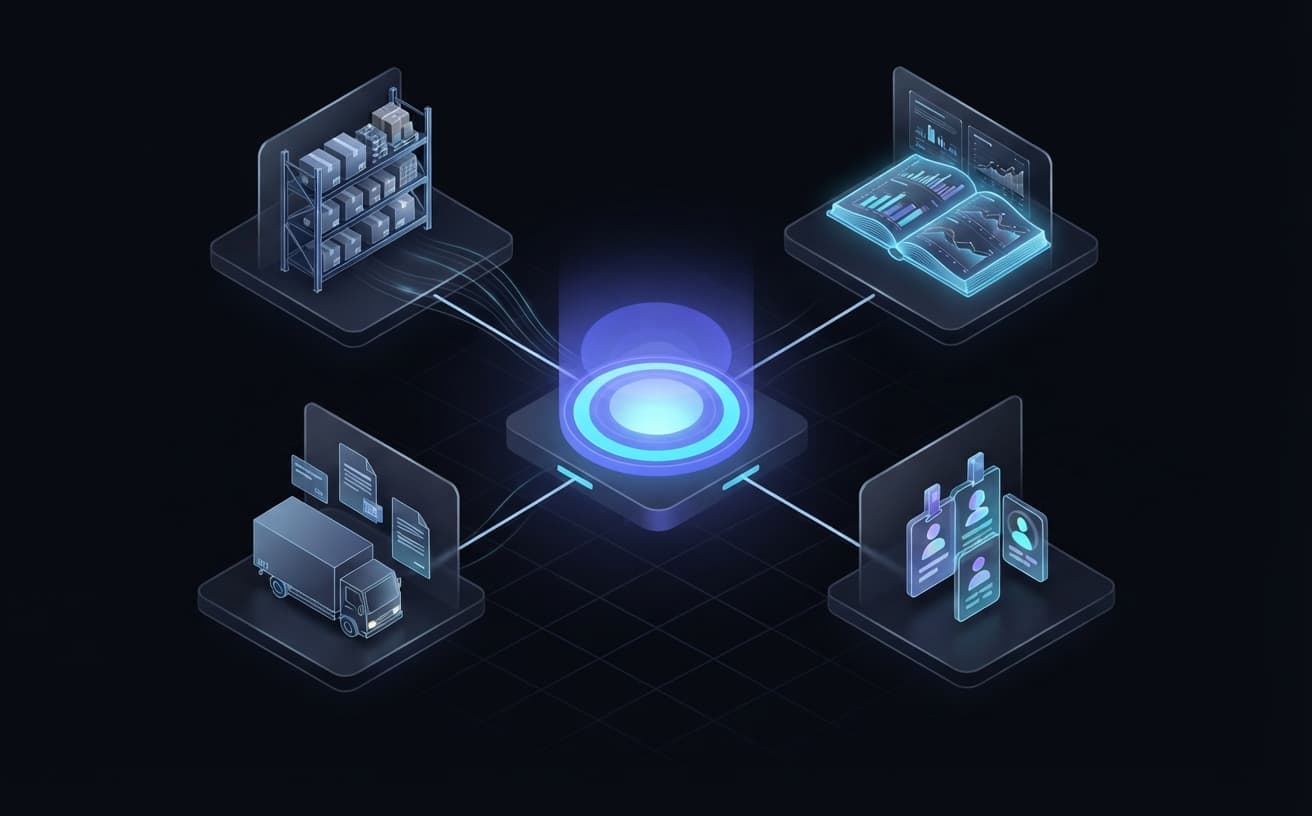
What a custom ERP system is
An ERP (enterprise resource planning) system is the software a company runs its core operations on: stock, purchasing, money, people and reporting, all sharing one set of data. A custom ERP is designed and built for a single business, so its screens, rules and reports match that business's real processes.
Packaged ERP products work well when your operations look like everyone else's. They get expensive when they don't: you pay for modules you never open, and then pay again for consultants to bend the product around the parts of your business that make you different. OGLAT builds the system the other way round. We start from how your teams work today and build only what they need.
The result is a system your staff can learn quickly, because it uses your terms and follows your steps, and one you can keep extending as the business changes.
The Problem
Signs you have outgrown spreadsheets and packaged software
Numbers that never match
Finance, warehouse and sales each keep their own records, so month-end turns into reconciling three versions of the truth.
Work that lives in spreadsheets
Critical processes depend on files only one or two people understand, with no history of who changed what.
Software that fights your process
Staff keep workarounds outside the system because the packaged product cannot model how you actually buy, stock or bill.
No view across locations
Each branch or warehouse reports separately, and a consolidated picture takes days to assemble.
What We Build
What we build into an ERP
Every ERP we build is scoped to the business, so you get the modules you need and nothing else. These are the ones most engagements include.
Finance & accounting
General ledger, payables and receivables, invoicing, tax handling and period close, with every entry traceable to its source document.
Inventory & warehousing
Stock levels by location, batch and expiry tracking, transfers, stock counts and reorder rules that reflect your real lead times.
Procurement
Purchase requests, approvals, purchase orders, goods received and supplier records in one connected flow.
HR & payroll
Employee records, attendance, leave, salary structures and payroll runs calculated to your own rules.
Roles, branches & permissions
Multi-location and multi-role access on web and mobile, so each person sees and changes only what their job requires.
Reporting & audit trails
Dashboards and scheduled reports for management, plus a full record of who did what and when.
How We Work
How an ERP project runs
- 01
Map the operation
We sit with the people who do the work, document each process as it really happens, and agree what the first release must cover.
- 02
Design the data model
Products, accounts, locations and roles are modelled first, because every module depends on getting that foundation right.
- 03
Build module by module
We ship in stages, starting with the area causing the most pain, so your team is using real software early instead of waiting for one big launch.
- 04
Migrate and switch over
Existing data is cleaned and imported, staff are trained on the live system, and the old spreadsheets are retired on an agreed date.
Who It's For
Where this fits best
- Distributors and wholesalers managing stock across several locations
- Retail groups, pharmacies and hardware businesses with complex inventory
- Manufacturers and service companies whose processes don't fit a packaged product
- Enterprises replacing a patchwork of spreadsheets and disconnected tools
FAQ
Questions we hear most
How is a custom ERP different from an off-the-shelf ERP?
An off-the-shelf ERP is a finished product you configure, and your processes adapt to it. A custom ERP is built for one business, so it follows your existing processes, uses your terminology and includes only the modules you need. The trade-off is that custom takes longer to deliver up front.
How long does a custom ERP take to build?
It depends on how many modules are in scope and how much existing data has to be migrated. We deliver in stages, so the first module is in use before the full system is complete. We give a timeline once your processes have been mapped.
Can we start with one module and add more later?
Yes, and it is the approach we recommend. Most clients begin with the area that hurts most, often inventory or finance, and add modules once that is running. The data model is designed from the start so later modules connect cleanly.
Can a custom ERP work with our existing accounting or POS software?
Usually, yes. If the existing tool has an API or can export data, we can sync with it instead of replacing it. During discovery we decide together which tools to keep, which to integrate and which the ERP should replace.
Who owns the system once it is built?
You do. The ERP is built for your business and handed over to you, and your team runs it.
Related Services
Often built alongside
Workflow Automation
Automated workflows connecting sales, operations, and fulfillment — so work moves without manual handoffs.
Learn moreCRM & Sales Platforms
Customer and sales data platforms tailored to your team's actual process, not a generic off-the-shelf template.
Learn moreCloud & System Architecture
Resilient backend systems and cloud infrastructure engineered for enterprise scale and reliability.
Learn moreReady to build with OGLAT?
Tell us what your team needs to run on, and we'll scope the system that gets you there.